
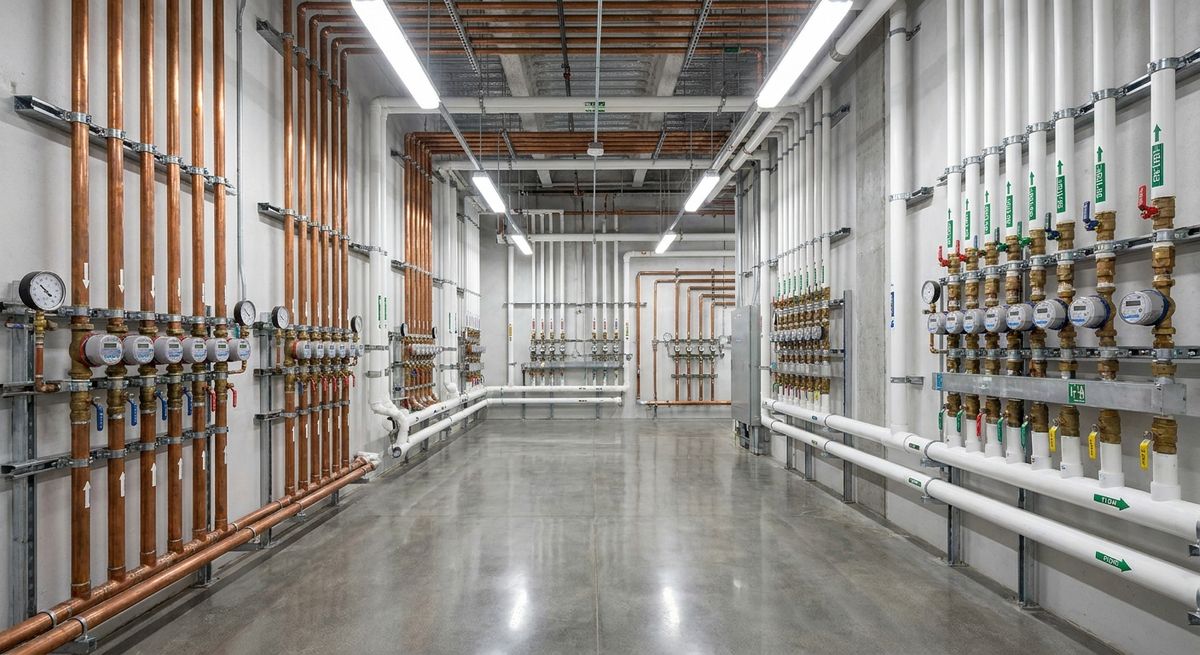
Commercial plumbing infrastructure
Back to Blog PLUMBING

Essential Plumbing Maintenance for Multi-Location Businesses

Apr 11, 2026 8 min read Alex Weber
Quick Read

This article covers:

  • Why multi-location plumbing fails differently than single-site systems
  • The 5 most common plumbing emergencies across retail, restaurant, and office portfolios
  • How to build a centralized maintenance calendar across all locations
  • Cost comparison: reactive emergency calls vs. planned maintenance contracts
  • Vendor management strategies that cut response times by 60%

Estimated read time: 5 minutes.

One clogged drain can shut down a restaurant for a full shift. One burst pipe can destroy $50,000 in retail inventory overnight. When you manage plumbing across multiple business locations, these aren't hypothetical scenarios — they're Tuesday.

The fundamental problem with multi-location plumbing is fragmentation. Each property has different pipe ages, different usage patterns, different local codes, and often different plumbing contractors who've never seen the other buildings. No one has the complete picture, so problems repeat across locations while solutions stay siloed.

This guide outlines a centralized approach to plumbing maintenance that reduces emergencies, controls costs, and keeps every location operational — whether you manage 3 properties or 30.

Warning Sign #01

Drain Backups in High-Volume Locations

Restaurants, cafeterias, and food courts generate heavy grease and solid waste loads. Without quarterly drain cleaning, main lines back up during peak hours — causing health code violations, lost revenue, and customer complaints that damage your brand across all locations.

Restaurant drains need quarterly professional cleaning
Grease traps must be pumped every 30–90 days
Floor drains in kitchens clog 3x faster than office drains
A single backup costs $500–$2,000 in emergency service + lost revenue
Scheduled cleaning costs $150–$300 per visit
Warning Sign #02

Water Heater Failures

Commercial water heaters serving multiple restrooms or kitchen operations are under constant demand. When they fail, it's not just cold water — it's a health department violation for food service locations that require 120°F minimum water temperature for sanitation compliance.

Commercial water heaters last 8–12 years with maintenance
Annual flushing prevents sediment buildup that cuts capacity by 30%
Anode rod inspection every 2 years prevents tank corrosion
Tankless units need annual descaling in NYC's hard water
Replacement planning should start at year 7–8
Warning Sign #03

Pipe Freezing in Unoccupied or Overnight Locations

Locations that close overnight or seasonally are vulnerable to frozen pipes when temperatures drop below 20°F. A single burst pipe in an empty building can run for hours before anyone notices — causing catastrophic water damage that affects neighboring tenants and triggers insurance claims.

Insulate all exposed pipes in unheated areas
Maintain minimum 55°F in all closed buildings during winter
Install smart water leak sensors at each location ($50–$100 each)
Know the main shut-off valve location at every property
Frozen pipe repairs average $1,000–$5,000; water damage can exceed $50,000
Warning Sign #04

Fixture Leaks Across High-Traffic Restrooms

Public restrooms in retail, office, and restaurant locations see 10–50x more usage than residential bathrooms. Faucets, flush valves, and supply lines wear out faster, and small leaks that go unreported by staff can waste 200+ gallons per day and cause floor damage beneath fixtures.

Commercial faucets need cartridge replacement every 2–3 years
Flush valves should be rebuilt annually in high-traffic restrooms
Running toilets waste 200 gallons/day ($0.50–$1.00/day in NYC water rates)
Train staff to report drips and running fixtures immediately
Quarterly fixture inspections catch problems before they escalate
Warning Sign #05

Sewer Line Deterioration

Older commercial properties (pre-1980) often have cast iron or clay sewer lines that corrode, crack, or collapse without warning. Root intrusion, bellied pipes, and joint separation cause slow drains that worsen over months — until a complete blockage triggers an emergency excavation costing $5,000–$15,000.

Camera inspection of main sewer lines every 2 years
Root treatment (copper sulfate or mechanical cutting) annually
Cast iron pipes older than 40 years should be assessed for replacement
Trenchless relining costs 40–60% less than traditional excavation
One proactive camera inspection ($300–$500) can prevent a $10,000+ emergency

Building a Centralized Plumbing Maintenance Calendar

The most effective multi-location plumbing strategy starts with a single document: a master maintenance calendar that covers every property, every system, and every scheduled service. Here's how to build one:

  1. Step 1: Inventory every plumbing asset. Walk each location and document: water heater age and model, number of fixtures, pipe material and approximate age, grease trap size and last pump date, main sewer line material and last inspection, and water shut-off valve locations.
  2. Step 2: Classify by risk. High-risk locations (restaurants, food service, medical) get quarterly service. Medium-risk (retail, office) get bi-annual service. Low-risk (storage, warehouse) get annual inspections.
  3. Step 3: Schedule by season. Spring: main sewer line inspections + drain cleaning. Summer: water heater flushing. Fall: pipe insulation + freeze prevention. Winter: weekly freeze checks at vulnerable locations.
  4. Step 4: Assign one vendor or coordinator. Having a single plumbing partner who knows all your locations eliminates the biggest source of multi-location waste: context switching. They learn your systems, anticipate recurring issues, and coordinate service across properties efficiently.
  5. Step 5: Standardize reporting. Every service visit should produce a written report documenting what was done, what was found, and what should be addressed next. This creates the maintenance history that prevents repeating the same diagnostic work at every call.
The Single-Vendor Advantage

Businesses using a single plumbing vendor across all locations report 60% faster emergency response times, 25% lower per-visit costs (volume pricing), and 40% fewer repeat issues. The vendor learns your systems, stocks common parts, and prioritizes your calls — benefits that fragment when you split work across multiple contractors.

ANNUAL PLUMBING COSTS PER LOCATION

Planned Maintenance vs. Emergency Calls

Planned: Quarterly Maintenance$1,200–$2,400/yr
Planned: Total Annual Plumbing$2,500–$4,000/yr
Reactive: Emergency Calls Only$4,000–$8,000/yr
Reactive: Total (incl. damage repair)$8,000–$15,000/yr

* Based on average NYC commercial location (restaurant/retail, 2,000–5,000 sqft). Includes labor, parts, and emergency surcharges.

Planned Maintenance vs. Emergency Response

Planned Maintenance (Recommended)
Annual plumbing cost: $2,500–$4,000 per location
Emergencies reduced by 70–80%
Consistent service quality across all locations
Predictable budgeting with fixed monthly costs
Complete maintenance records for insurance/audits
Single vendor who knows every property
Emergency-Only Approach (Not Recommended)
Annual plumbing cost: $8,000–$15,000 per location
Average 4–6 emergencies per location per year
Different plumber every time — no system knowledge
Unpredictable costs that blow quarterly budgets
No documentation — insurance claims harder to file
After-hours rates 50–100% higher than planned visits
The Multi-Location Multiplier

Plumbing problems don't scale linearly — they multiply. A 5-location portfolio doesn't have 5x the plumbing issues of a single location; it has 8–10x. Why? Because best practices that develop naturally at a single site ("the third-floor toilet always runs — jiggle the handle") never transfer to other locations. Centralized maintenance captures and resolves these patterns systematically.

Vendor Management for Multi-Location Plumbing

Choosing the right plumbing partner for a multi-location portfolio is fundamentally different from hiring a plumber for a single building. You need a vendor who can provide:

  • Scalable coverage. Can they service all your locations? If properties span multiple boroughs or counties, confirm service area coverage before signing.
  • Priority response agreements. Multi-location contracts should include guaranteed response times — typically 2–4 hours for emergencies, same-day for urgent issues, and within 48 hours for routine requests.
  • Comprehensive capabilities. Drain cleaning, water heater service, fixture repair, sewer line work, and backflow testing — all from one team. Every additional subcontractor adds cost and coordination overhead.
  • Digital reporting. Every visit should generate a digital report with photos, findings, and recommendations — accessible to your entire facilities team, not buried in one manager's email.

The right vendor becomes a strategic partner — not just a service provider. They'll identify patterns across your portfolio ("three of your five locations have the same corroding supply lines"), recommend water quality improvements that prevent recurring issues, and help you budget for capital replacements before they become emergencies.

The best time to find a plumbing partner is before you need one urgently. Vet vendors when there's no emergency — so when a pipe bursts at 2 AM, you already have a number to call and a contract that guarantees response.

MULTI-LOCATION PLUMBING

Frequently Asked Questions

Find answers to common questions about our HVAC, plumbing, and refrigeration services.

High-volume locations (restaurants, food service) need quarterly inspections. Standard commercial spaces (retail, office) should have bi-annual inspections — spring and fall. All locations should have main sewer lines camera-inspected every 2 years, regardless of industry. Annual water heater flushing is recommended for all commercial properties.

For most multi-location businesses, a single vendor is significantly better. You get volume pricing (typically 15–25% lower per-visit costs), faster response times through priority agreements, consistent service quality, and a vendor who learns the patterns across your portfolio. The exception is if your locations span multiple states — then a regional vendor for each market with centralized coordination is more practical.

Grease trap overflow and drain line backups. Restaurants generate heavy grease loads that accumulate in drain lines and grease traps. Without regular pumping (every 30–90 days depending on volume), grease solidifies in the main line, causing backups during peak service hours. A single backup can close a location for 4–8 hours, costing $2,000–$5,000 in lost revenue plus emergency plumbing fees.

Three steps: (1) Insulate all exposed pipes in unheated areas — basements, crawl spaces, exterior walls. (2) Maintain minimum 55°F in all buildings during winter, even when closed. (3) Install smart water leak sensors at vulnerable points — they alert you within minutes of a leak or temperature drop, giving you time to respond before a burst pipe causes $10,000–$50,000 in water damage.

Typical multi-location plumbing maintenance contracts in NYC run $1,200–$2,400 per location per year for quarterly service. This includes scheduled drain cleaning, fixture inspections, water heater maintenance, and priority emergency response. Most businesses with 5+ locations negotiate volume discounts of 15–25%. Compared to emergency-only spending of $8,000–$15,000 per location, planned maintenance saves 60–80% annually.

Limited Availability

Protect Every Location — One Plumbing Partner

Managing plumbing across multiple properties shouldn't mean multiple headaches. We service multi-location businesses throughout NYC with a single point of contact, priority response, and volume pricing that simplifies your facilities budget.

Alex Weber

Marketing and Sales dept